Agriculture does not operate in isolation. It is shaped by research, education, markets, policies, and environmental conditions. Yet for many years, innovation in agriculture often remained fragmented—new ideas stayed within research institutions, while farmers struggled to access practical solutions.
Sustainable agricultural growth depends on collaboration.
Modern farming challenges are complex. Addressing climate change, resource efficiency, and food security requires knowledge from multiple fields – agronomy, ecology, economics, digital technologies, and social sciences. No single institution or actor can address these challenges alone.
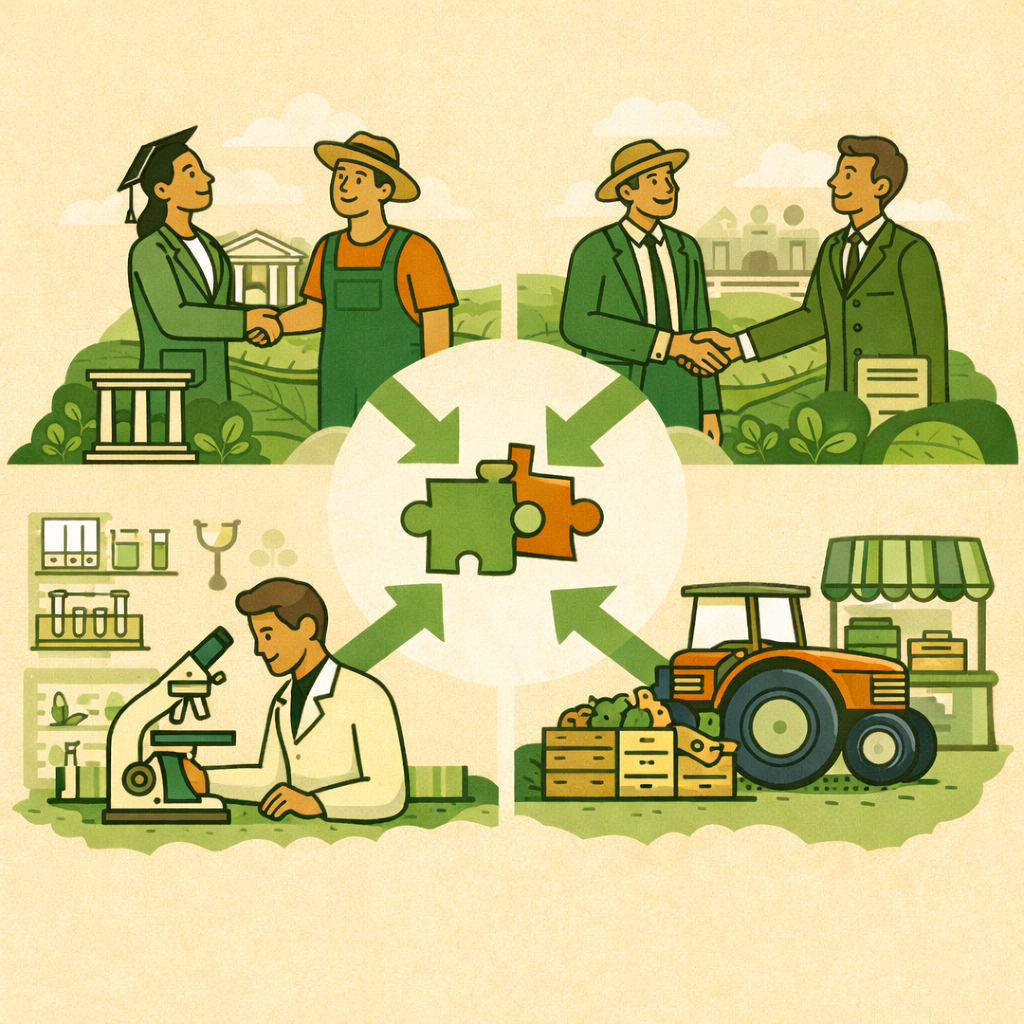
Collaboration creates connections between theory and practice. When universities, farmers, agribusinesses, and policymakers work together, innovation becomes more relevant and more accessible. Practical feedback from farmers improves research outcomes. Educational programmes become better aligned with labor market needs. Businesses gain access to skilled professionals who understand both technology and sustainability.
ReGrow is built on this collaborative approach. By fostering cooperation between educational institutions and agricultural stakeholders, the project supports shared learning and mutual benefit. Knowledge flows in multiple directions – research informs practice, while real-world experience shapes education.
Collaboration also reduces risk. Solutions tested in one context can be adapted elsewhere, saving time and resources. Shared experiences strengthen resilience across regions and communities.
Perhaps most importantly, collaboration democratizes innovation. It ensures that progress is not limited to large-scale producers or advanced institutions, but can reach smaller farms, rural communities, and emerging professionals.
In agriculture, growth is strongest when it is shared. Collaboration turns individual efforts into collective progress – and that is what makes it the real engine of sustainable development.